
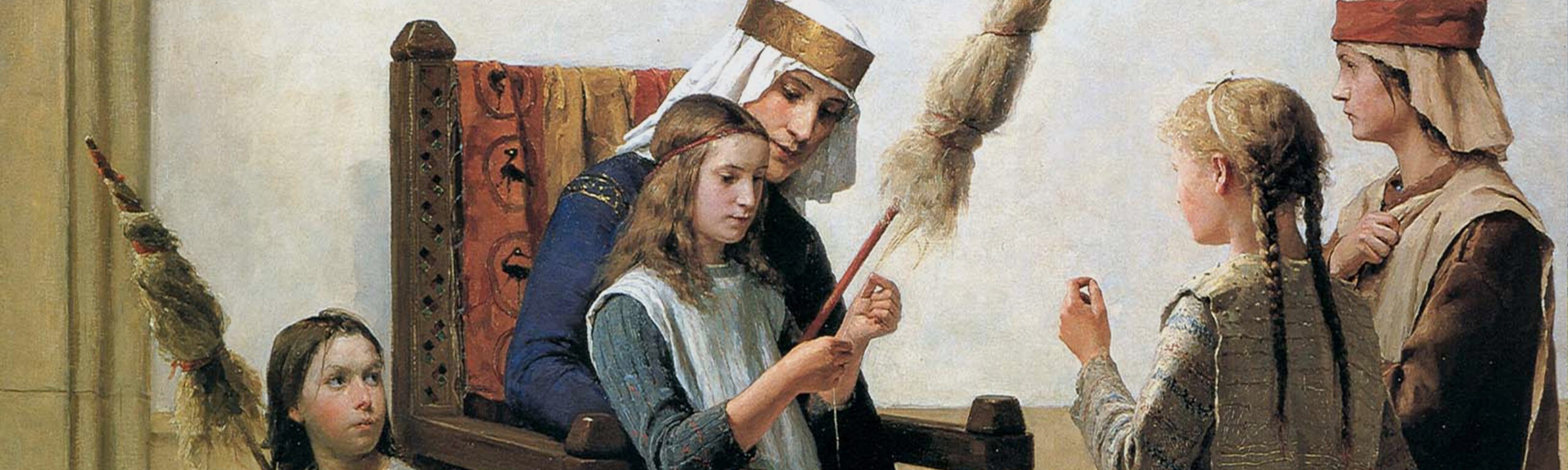
Spindle Whorls and Loom Weights
In the Middle Iron Age there was a funerary tradition of human bodies being placed in a crouched position within pits, where the deceased were sometimes associated with grave goods; typically joints of meat, stone objects such as quern stones and pottery and objects associated with weaving, whether spindle whorls or loom weights. [1]
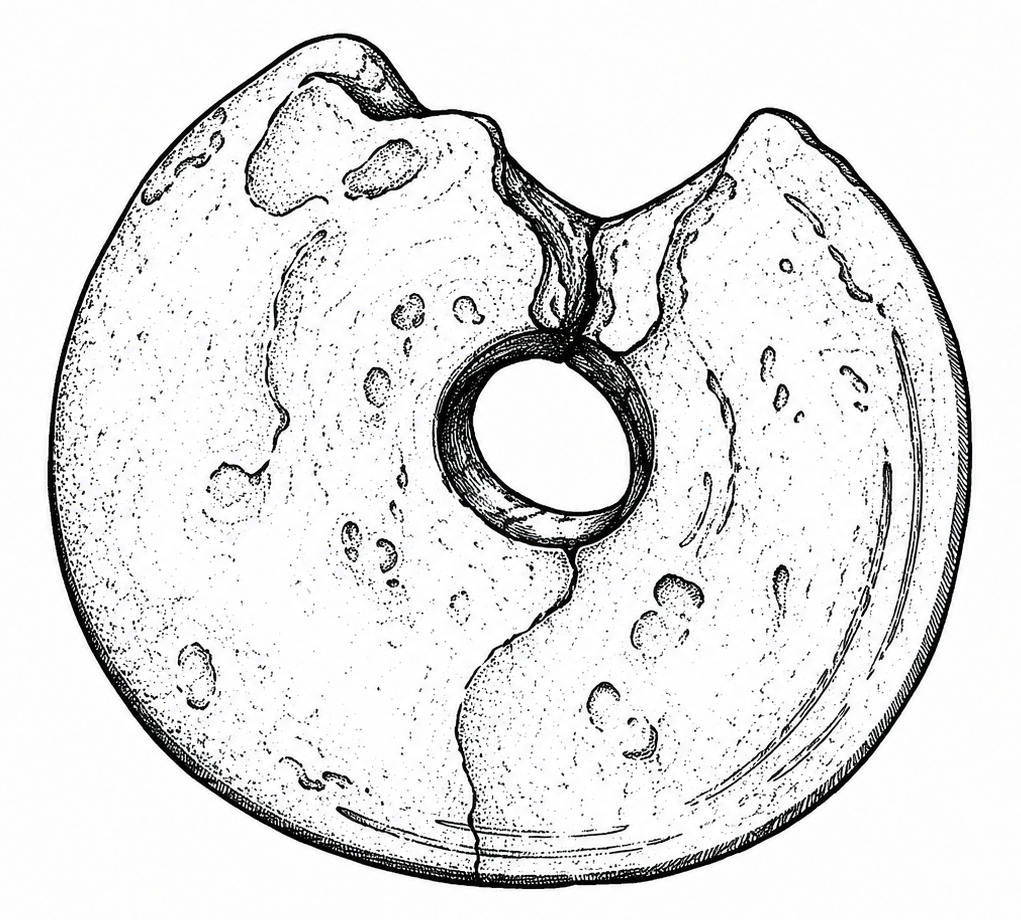
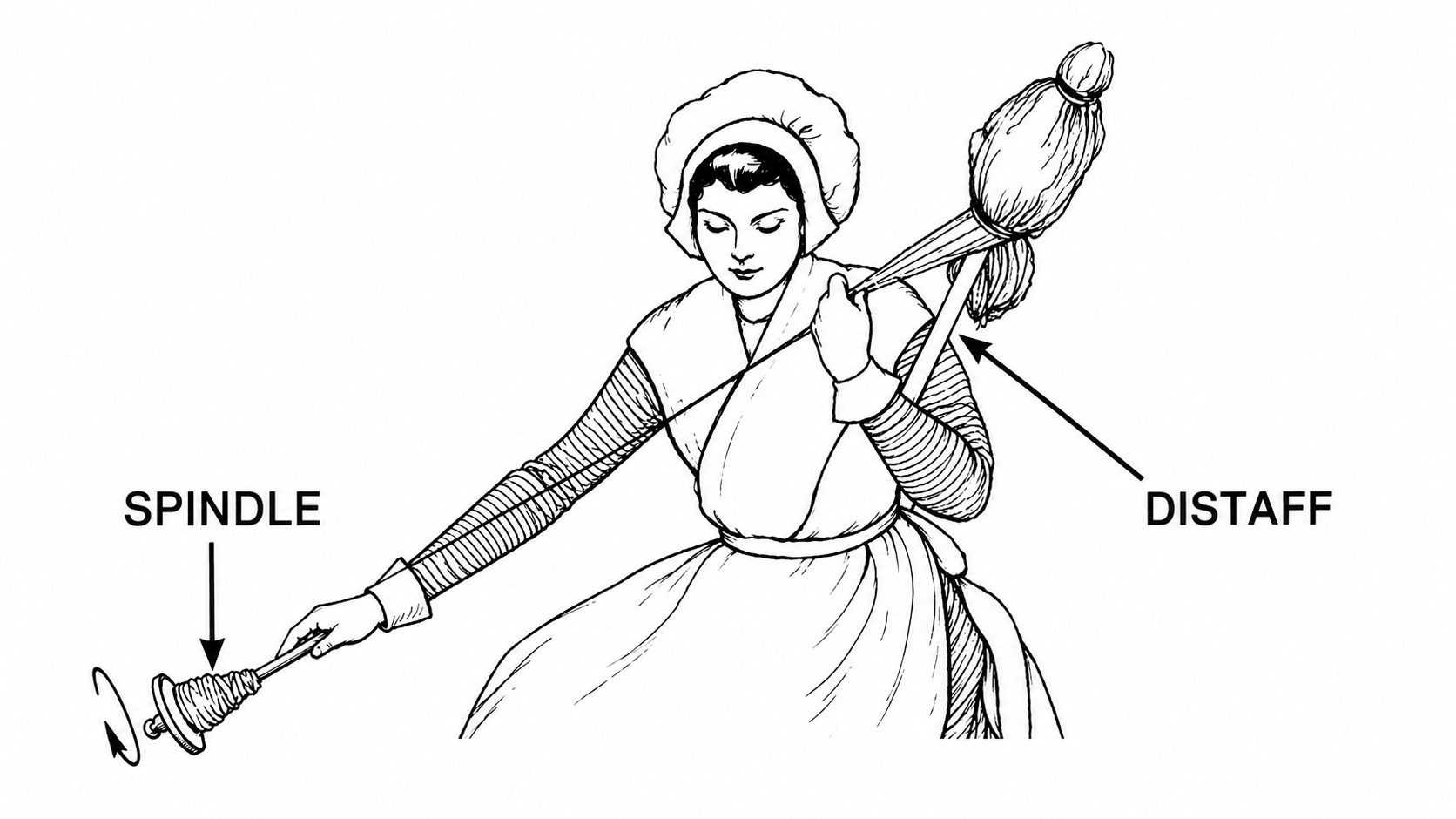
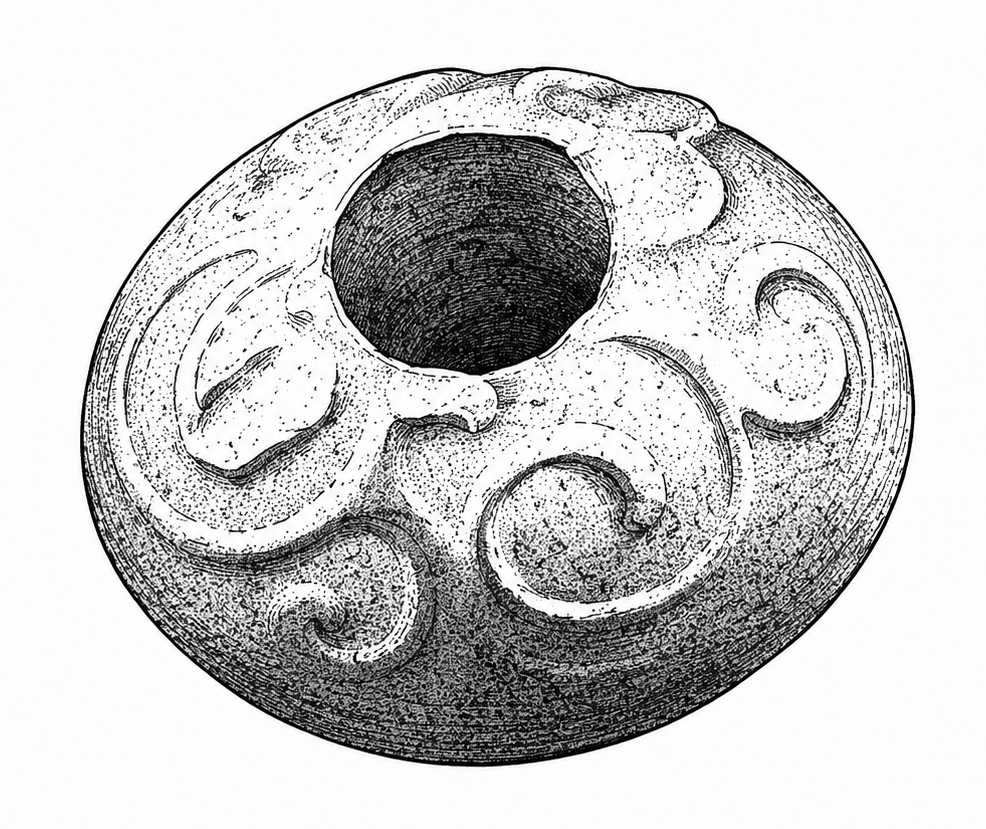
A spindle whorl, being usually either a disc or bead‑shaped object with a hole in the centre, is used as part of a drop spindle in the craft of hand spinning. The whorl attached to the spindle acted as a weight to help provide momentum whilst spinning and twisting the fibres together. A wooden shaft fits into the hole in the spindle whorl and together they are spun to create yarn. This method of preparing yarn has been in use since prehistoric times through to post‑medieval periods. In contrast, clay loom weights were employed in weaving rather than spinning, serving to keep the warp threads taut on a vertical loom and thus enabling the production of woven cloth.
Whilst some of the objects associated with weaving described above might be considered solely functional and rudimentary, both the activity of weaving and the objects central to the act itself have been symbolically associated with worldwide cosmologies spanning many centuries.
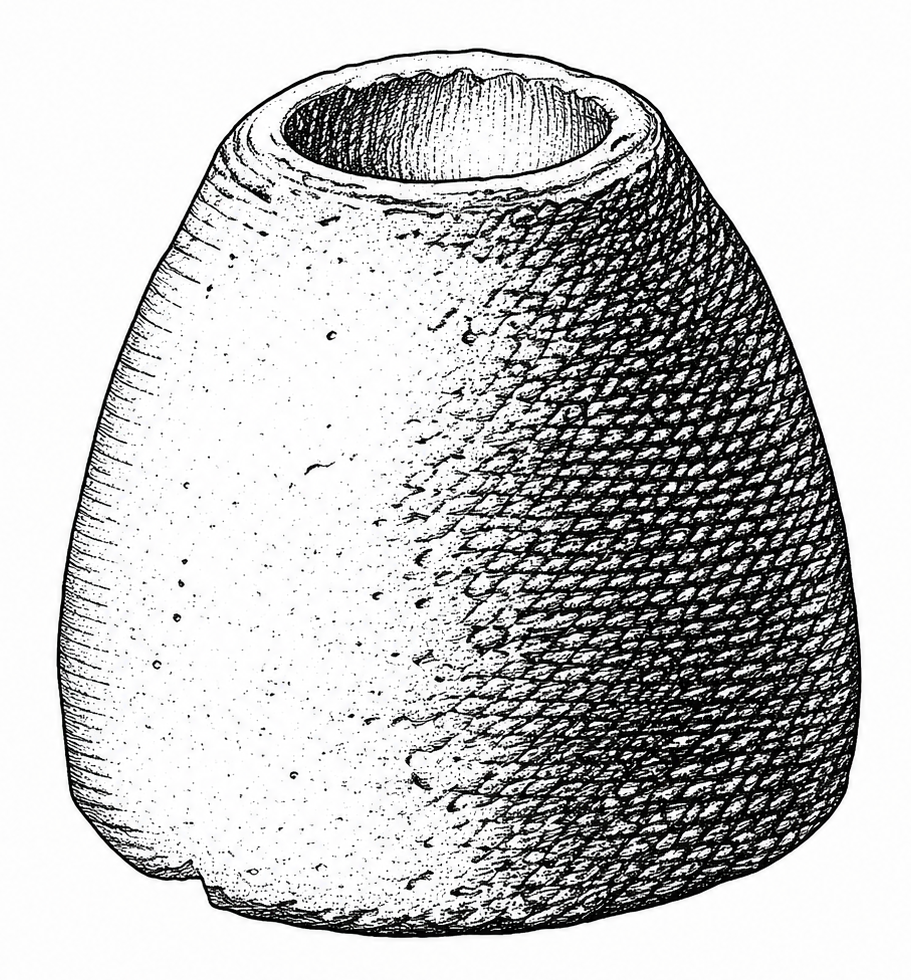
Across Suffolk, loom weights have been documented at 11 locations out of 29 Iron Age sites. [2] Clay loom weights were a distinctive part of the material culture of the Early to Late Iron Age. [3] Their presence is unusually rare in the Southeast, and they are “found in few sites” across East Anglia during the Iron Age period. [4]
A chalk spindle whorl accompanied an elderly Middle Iron Age woman buried at Rudston in grave R92 and appears to have been placed at the right shoulder, as if worn as a pendant. [5] The deposition of spindle whorls in late Bronze Age burials which generally appear to have been well made and finished, similar to the workmanship of the one discovered at Cumberland’s Mount, would indicate that these “may have been valued personal possessions”. [6] They have also often been found in Late Bronze Age–Early Iron Age barrows in Buckinghamshire at Bledlow Cop and in Late Iron Age to Roman cremation burials at Aston Clinton, associated with high status activity or ritual function. [7] This structured deposition and funerary practice continued into Late Antique and early medieval cremation graves where objects typically would include brooches, glass beads and vessels, spindle-whorls, tweezers, shears, and combs. [8]
Whilst the spindle whorl discovered at Cumberland’s Mount, Staverton, in Suffolk, was undecorated on its surface, Iron Age symbols on other objects, such as glass beads, frequently use a whirl or ray motif which “would have been hypnotic when [in motion]”. It may also be significant that these simple designs are also found in the first few stages of entoptic phenomena, which are seen during altered states of consciousness”. [9, 10] The mystery of Iron Age burials includes the diverse treatment of the deceased, including inhumations, cremations, completely disarticulated pieces of human bone and semi-articulated portions of bodies, such as a jawbone. “There are even pieces of modified human bone like the pierced femur heads from some sites where they seem to have been used as spindle whorls, or the pierced skull plates that seem to have been hung on strings for display”. [11]
The ancient Finnish festival of kekri coincided with the start of the year in late autumn, close to our present All Saints’ Day, 1 November. [12] The word kekri comes from kekräj, an Indo-European loan word from around 2000 BC and means “wheel” or “cycle” and according to Ridderstad may have originally been a solar festival attached to the mid-quarter date in November. [13] The Finnish word kehrä means the disk of the sun, thus kekri relates to the wheel of the solar year, with both words relating to kehrata, “to spin” with the cycle starting anew. [14]
Spinning was a key activity of the solar goddesses Paivatar and Kuutar, whose threads were the rays of the moon and sun, controlling both the annual vegetation cycle and the fates of humanity when the wheel of time turned and both were later Christianised as the Virgin Mary. [15]
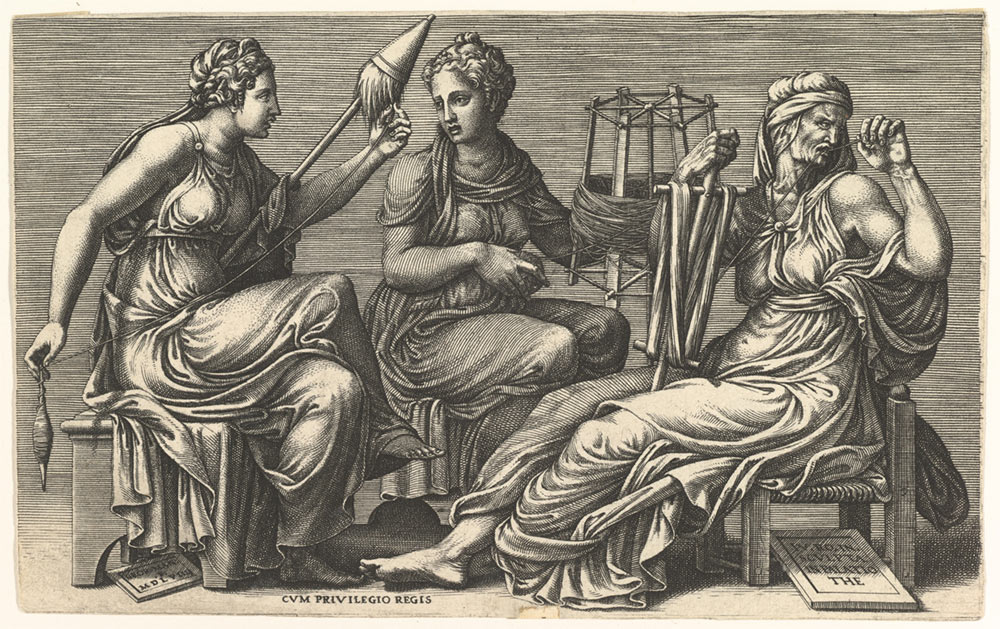
Cosmologies often included viewing the celestial pole and the circumpolar constellations as rotating around an invisible ‘celestial spindle’ which cosmically wove the fates of existence and symbolically linked with ideas of fortune telling, all inherently related to the cosmic spindle or loom of time, such as the Greek Moirai, the Germanic Norns, the Roman Parcae, the Hattic goddesses Estustaya and Papaya and the Lithuanian Verpeia. [16]
The art of weaving was considered to have revealed something about the secrets of space-time that ruled “the cycles of life and death.” [17] As such, looms and spindles came to symbolise fate which dominated “the cosmos, spinning the threads of life, in particular the human existence.” [18]
References
- Cooper, L., Garrow, D., Gibson, A., Giles, M. & Wilkin, N. (2021) Grave Goods: Objects and Death in Later Prehistoric Britain. Oxford: Oxbow Books.
- Rippon, S. (2018) Kingdom, Civitas, and County. The Evolution of Territorial Identity in the English Landscape. Oxford University Press.
- Rippon, S. (2018) Ibid.
- Rippon, S. (2018) Ibid.
- Stead, I.M. (1991) Iron Age Cemeteries in East Yorkshire. Excavations at Burton Fleming, Rudston, Gartonon-the-Wolds, and Kirkburn. London: English Heritage/British Museum Press.
- Brown, N and Medlycott, M. (2013) The Neolithic and Bronze Age Enclosures at Springfield Lyons, Essex: Excavations 1981–1991, East Anglian Archaeology, 149, Chelmsford: Essex County Council.
- Gregory, A. (1992) Excavations at Thetford, 1980-82, Fison Way. East Anglian Archaeology Monograph.
- Lucy, S. (2000) The Anglo-Saxon Way of Death. Stroud: Sutton Archaeology No. 53
- Foulds, E., M. (2014) Glass Beads in Iron Age Britain: a social approach. Doctoral thesis, Durham University.
- Lewis-Williams, J. D. (1997) Agency, Art and Altered Consciousness: A Motif in French (Quercy) Upper Palaeolithic Parietal Art. Antiquity, 71( 274).
- The mystery of Iron Age burials, Sean Lisle1 Monday, February 13, 2017. https://archaeologyorkney.com/2017/02/13/the-mystery-of-iron-age-burials/
- Ridderstad, M. P. (2016) The Bear and the Year: on the origin of the Finnish Late Iron Age folk calendar and its connection to the Bear Cult, Mediterranean Archaeology and Archaeometry. International Journal, vol. 16, no. 4.
- Ridderstad, M. P. (2016) Ibid.
- Ridderstad, M. P. (2015) Solar and Calendrical Symbolism in the Early Medieval Finnish Church Murals. SEAC 2011 Stars and Stones: Voyages in Archaeoastronomy and Cultural Astronomy.
- Ridderstad, M. P. (2015) Ibid.
- Rappenglück, M. (2007) : Cosmic spinning and weaving: Making the Texture of the World. BAR S1647 Pasztor (Ed.) Archaeoastronomy in Archaeology and Ethnography. Archaeoastronomy in Archaeology and Ethnography Papers from the annual meeting of SEAC (European Society for Astronomy in Culture) held in Kecskemét in Hungary in 2004
- Rappenglueck, M. (2007) Ibid.
- Rappenglueck, M. (2007) Ibid.