
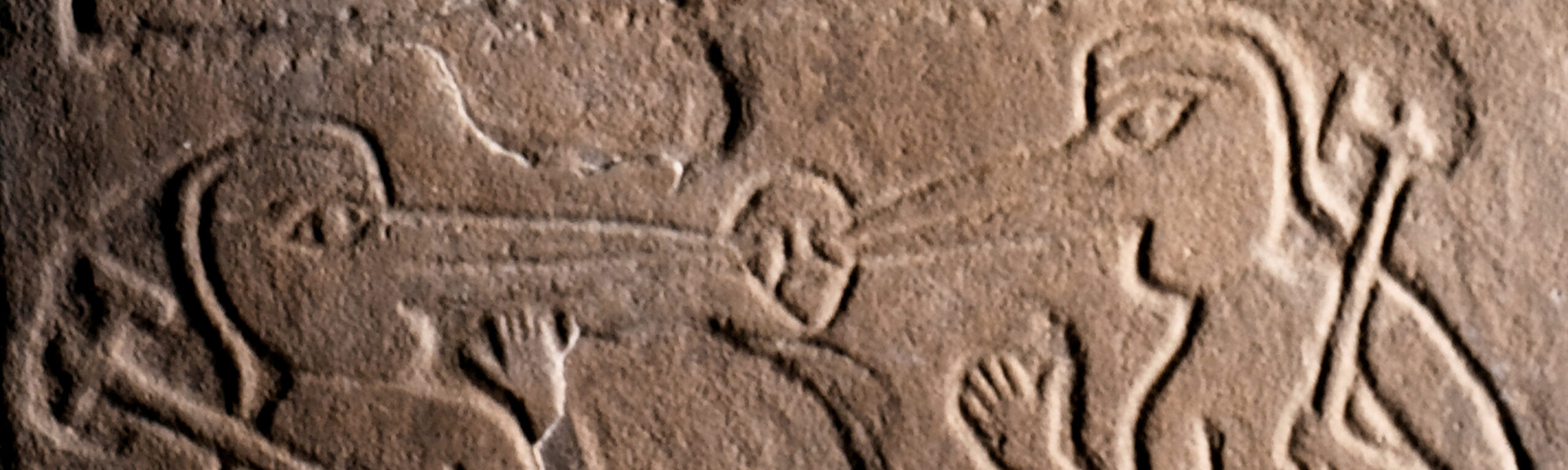
Papil Birdmen
The bird-men stone from Burra, Shetland, in an area called Papil, is a cross-slab with bizarre mythical iconography that continues to elude clear explanation.
The bird-men stone stands out as one of the most enigmatic examples among the roughly 350 carved stones attributed to the Picts (a term generally applied to the peoples living north of the Forth-Clyde line from around 300 to 843 AD) and is described as “by far the most unusual.” [1]
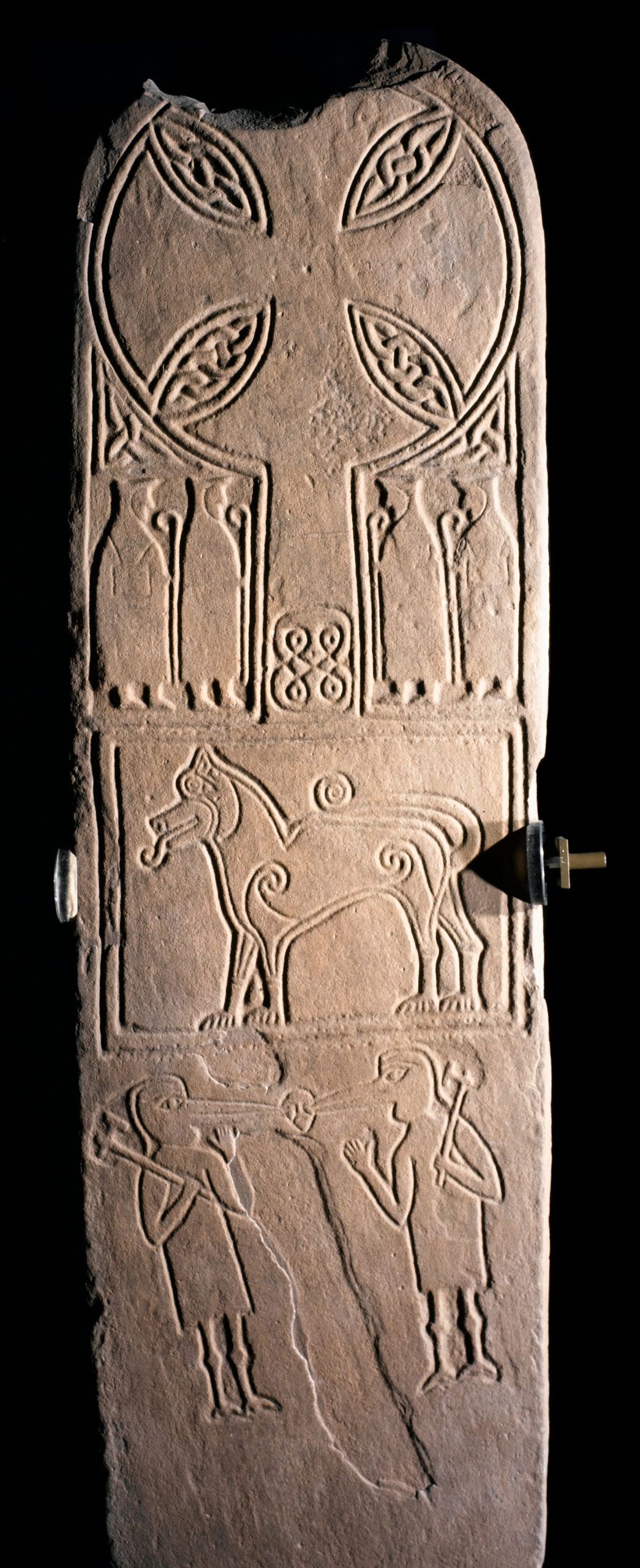
The site of St Laurence’s Church, where the stone was found was a major early medieval monastic centre and possibly the principal monastery for southern Shetland. [2] The slab’s date is also disputed, ranging from the 7th century, based on the circular cross head [3] or from towards the end of the 8th century, aligning it with the onset of Viking expansion across the North Atlantic [4] with the stone now more commonly dated to the 9th century. [5]
The stone’s dominant cross may suggest a Christian context; however, the bird-men motif resists an easy theological interpretation. The deliberate positioning of the stone within a ritualised landscape potentially invites consideration of its symbolic or cosmological significance, one that may have been intended to align it with natural features, such as water sources, promontories, or sightlines.
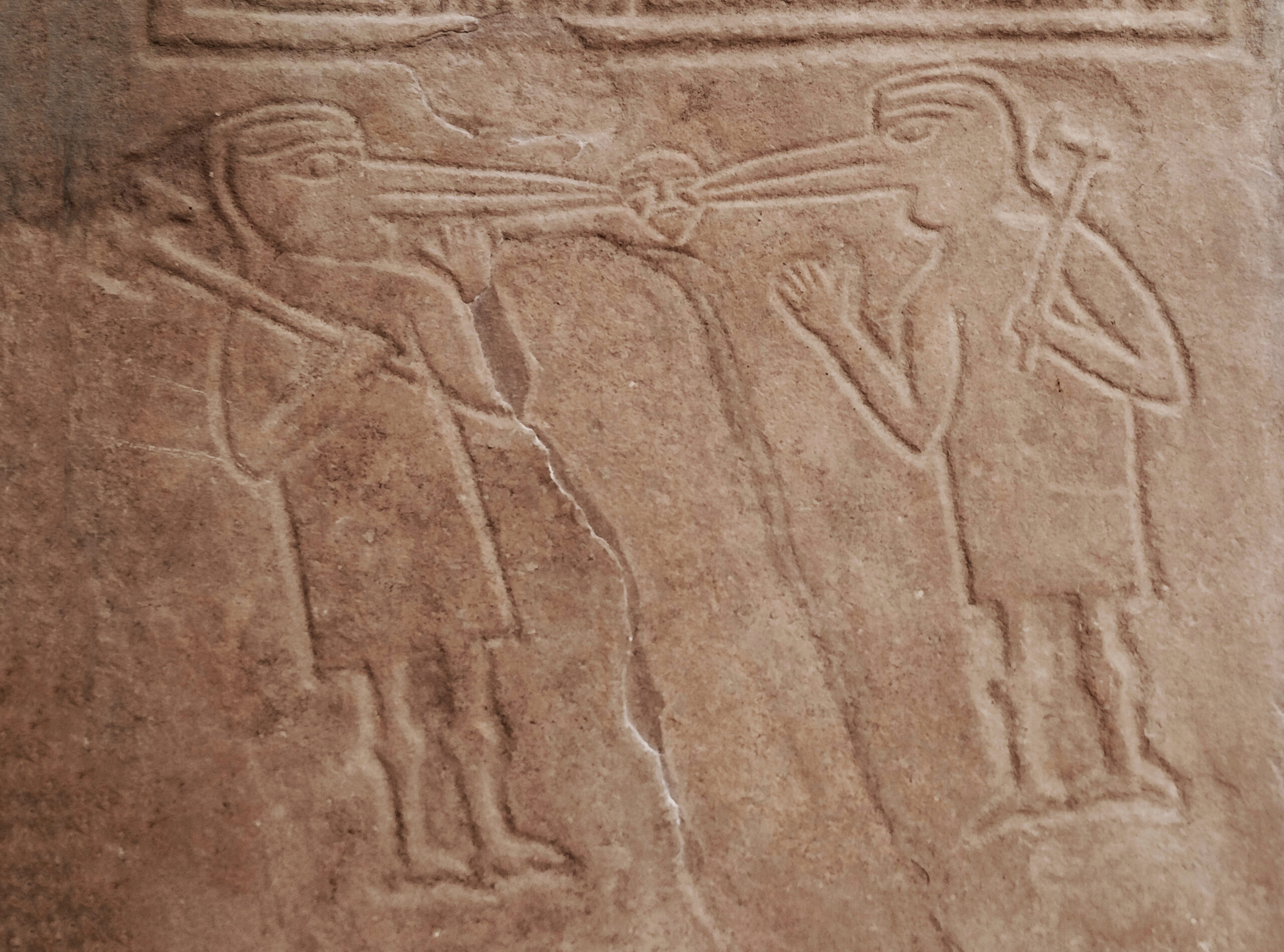
The bird-men are strikingly detailed, with their beaks measuring 10 cm long, while they stand on thin, elongated, spindly bird legs with bulbous protruding knees, terminating with taloned feet. The bird-man on the left measures 37 cm in height with the figure on the right slightly shorter at 36 cm. [6] Both wear unbelted tunics, and each grips a T-shaped axe with a slender shank. Between their beaks, the figures grasp a small, incised human head with almond-shaped eyes, to which they appear to “convey their insidious messages into the ears of a human head” [7] a scene suggestive of symbolic communication or spiritual confrontation. Does the head represent a victim, perhaps even a severed head? Is it a soul in peril, suspended between demonic tempters?
The symmetrical composition and central placement of the human head may imply a deliberate visual balance, possibly reflecting cosmological dualities, judgment, transition, or or spiritual mediation, reflecting cosmological dualities such as light and dark, or the human and the otherworldly.
Through comparison with Irish sculptural traditions, the bird-headed figures have been read in relation to the temptation of St Antony in the Vita Antonii by Athanasius of Alexandria (4th century AD), in which Antony is tormented by demons who appear in animal or bird form whispering in a malevolent fashion. [8] This interpretation has, however, been questioned, particularly where it is seen to impose continental Christian motifs onto a visual tradition that appears distinctly local in character. [9]
Mythological scenes are largely absent from Irish Christian monuments, though parallels can be drawn with certain Norse cross-slabs, which do incorporate imagery derived from pre-Christian mythologies. [10] The Papil Stone has close parallels with other Insular stones that depict aggressive, otherworldly figures, suggesting a shared perception of spiritual struggle or liminal confrontation. [11] As such, might we be witnessing liminal beings, mediating between human and supernatural realms, something that perhaps echoes broader Pictish and Celtic traditions, one where landscape features such as springs, hills and burial grounds were seen as portals or boundaries? In this schema, the enigmatic figures could be seen as supernatural warriors or guardians and part of a broader Pictish iconographic tradition of armed, hybrid figures. These beast-headed or monstrous otherworldly figures are often depicted in martial or ritual contexts, and may suggest “the Pictish concept of an otherworldly struggle.” [12]
The Papil Stone may be read within the framework of a ritual landscape. Its original placement at a monastic site, likely chosen for its proximity to natural features and visibility within the local terrain, may hint at a spatial logic beyond mere decoration. The opposition between the bird-men and the human head may mark a symbolic threshold between sacred and profane, life and death, human and otherworldly. Such oppositions are common in Insular iconography and may encode a ritual logic in which the stone functions as a visual mediator between realms.
Rather than a Christian allegory alone, the stone’s composition may reflect a logic rooted in indigenous cosmology, in which it may have functioned as part of a ritual geography, encoding mythological narratives and beliefs into the landscape itself. Today, the stone’s imagery and interpretation remain caught between forces, worlds, and meanings.
References
- Kilpatrick, K.A. (2011) ‘The iconography of the Papil Stone: sculptural and literary comparisons with a Pictish motif’, Proceedings of the Society of Antiquaries of Scotland, 141.
- Thomas C (1971) The Early Christian Archaeology of North Britain. London. Oxford University press for the University of Glasgow.
- Curle, C L 1939–40 ‘The Chronology of the Early Christian Monuments of Scotland’, Proc Scot Antiq Scot 74, Curle, C L 1940 ‘The Chronology of the Early Christian Monuments of Scotland’, Proc Soc Antiq Scot, 74 (1939-40) .
- Stevenson, R.B.K. (1981) ‘Christian sculpture in Norse Shetland’, Frodskaparrit: Annales Societatis Scientiarum Færoensis, 29.
- Kilpatrick, K.A. (2011) Ibid.
- Kilpatrick, K.A. (2011) Ibid.
- Henderson, I. (1997) Pictish monsters: symbol, text and image. Cambridge: Department of Anglo-Saxon, Norse and Celtic, University of Cambridge. (H.M. Chadwick Memorial Lectures, 7.
- Henderson, I. (1997) Ibid.
- Kilpatrick, K.A. (2011) Ibid.
- Bailey, R.N. (2000) ‘Scandinavian myth on Viking-period stone sculpture in England’, in Barnes, G. and Clunies Ross, M. (eds) Medieval Scandinavia and Christian Europe in the Middle Ages: Papers from the 10th International Saga Conference. Sydney: Centre for Medieval Studies, University of Sydney.
- Kilpatrick, K.A. (2011) Ibid.
- Kilpatrick, K.A. (2011) Ibid.