
Sandbach Crosses
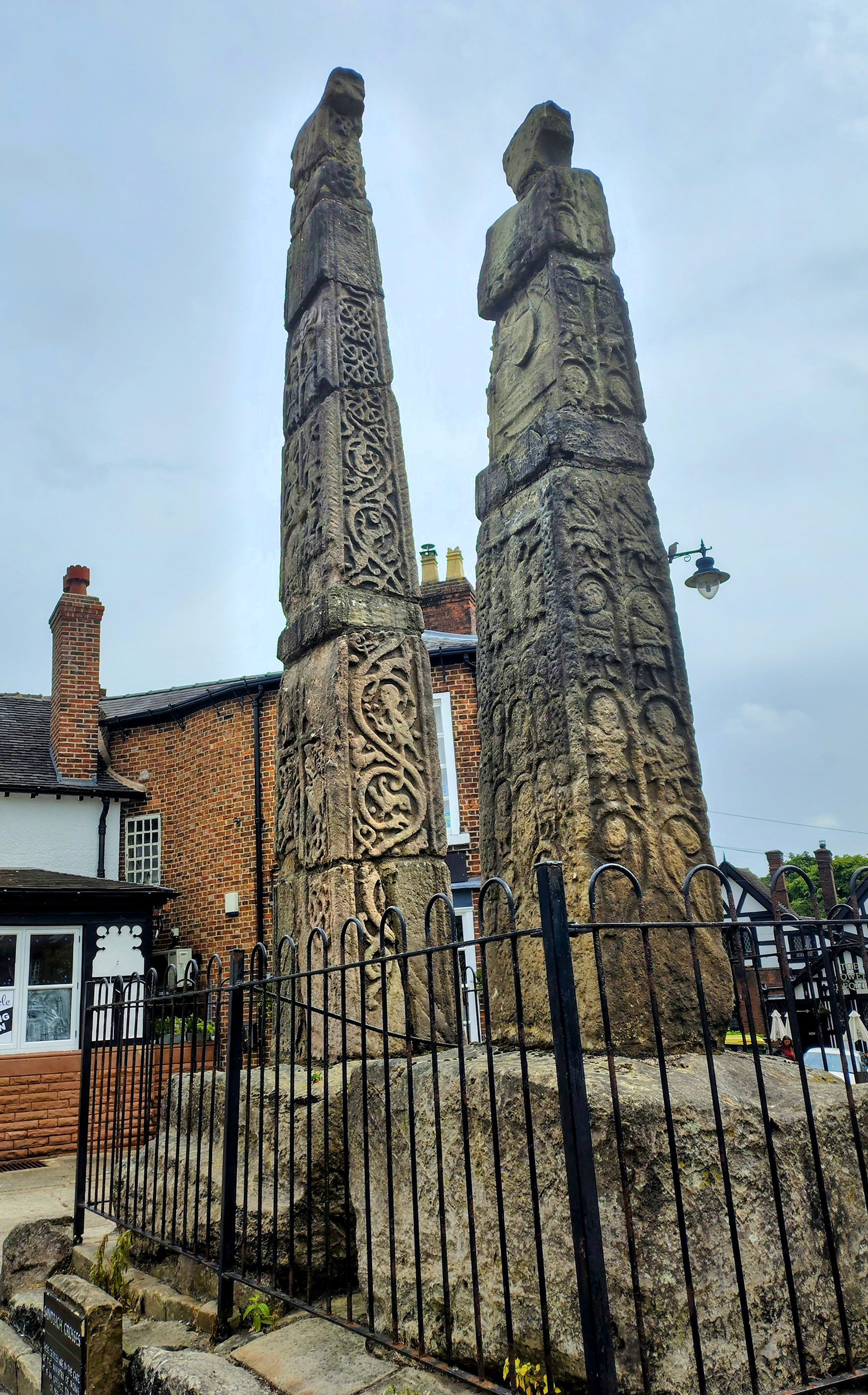
The Sandbach Crosses are a pair of richly decorated stone monuments in Sandbach, Cheshire, often regarded as among the most significant surviving early medieval monuments. [1] Originally among the tallest in England, the larger cross measures 16 feet 8 inches, while the smaller, more fragmentary, stands at 11 feet 11 inches. [2] If its circular head measured three feet across, the taller cross would have reached nearly twenty‑five feet. [3] Iconographic evidence suggests the larger was carved in the early 9th century, with the smaller being completed in the middle of the 9th century. [4]
The stepped base, nearly 5 feet high, is contemporary with the monuments. [5] In 1816 the crosses were relocated to their current location, based on a 16th century arrangement from an unknown site. [6] The crosses are traditionally linked to Peada, son of Penda of Mercia, baptised in 653 to marry Oswiu’s daughter. Although Penda remained pagan, Sandbach’s frontier position suggests they marked the first Mercian preaching of Christianity, [7] though this view is disputed. [8]
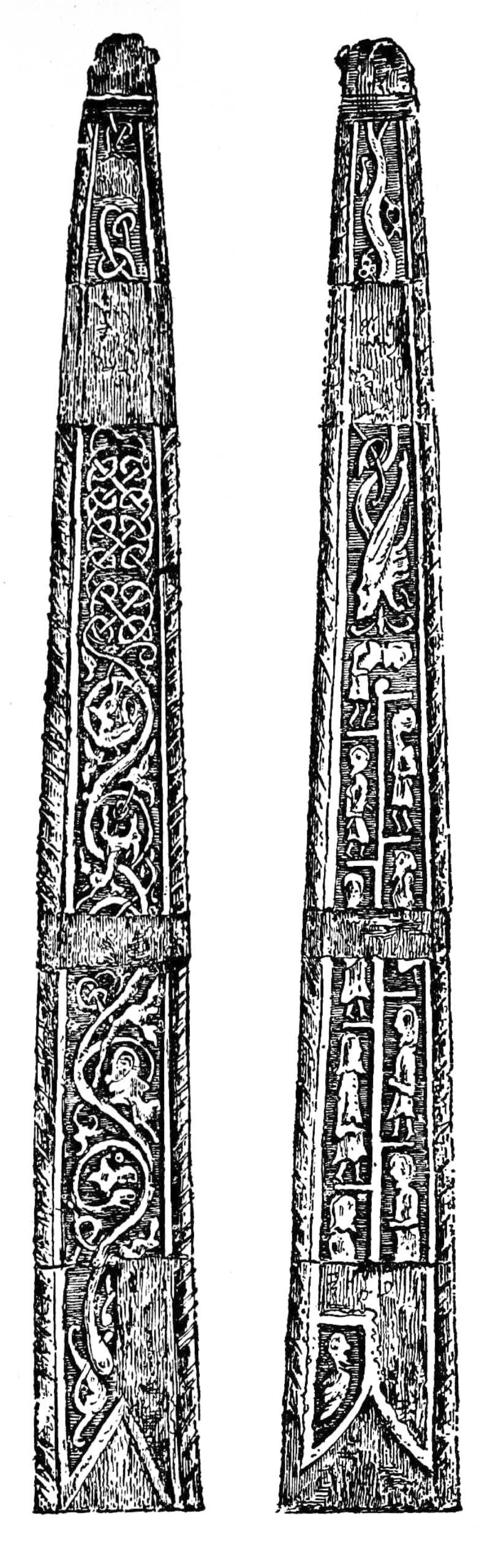
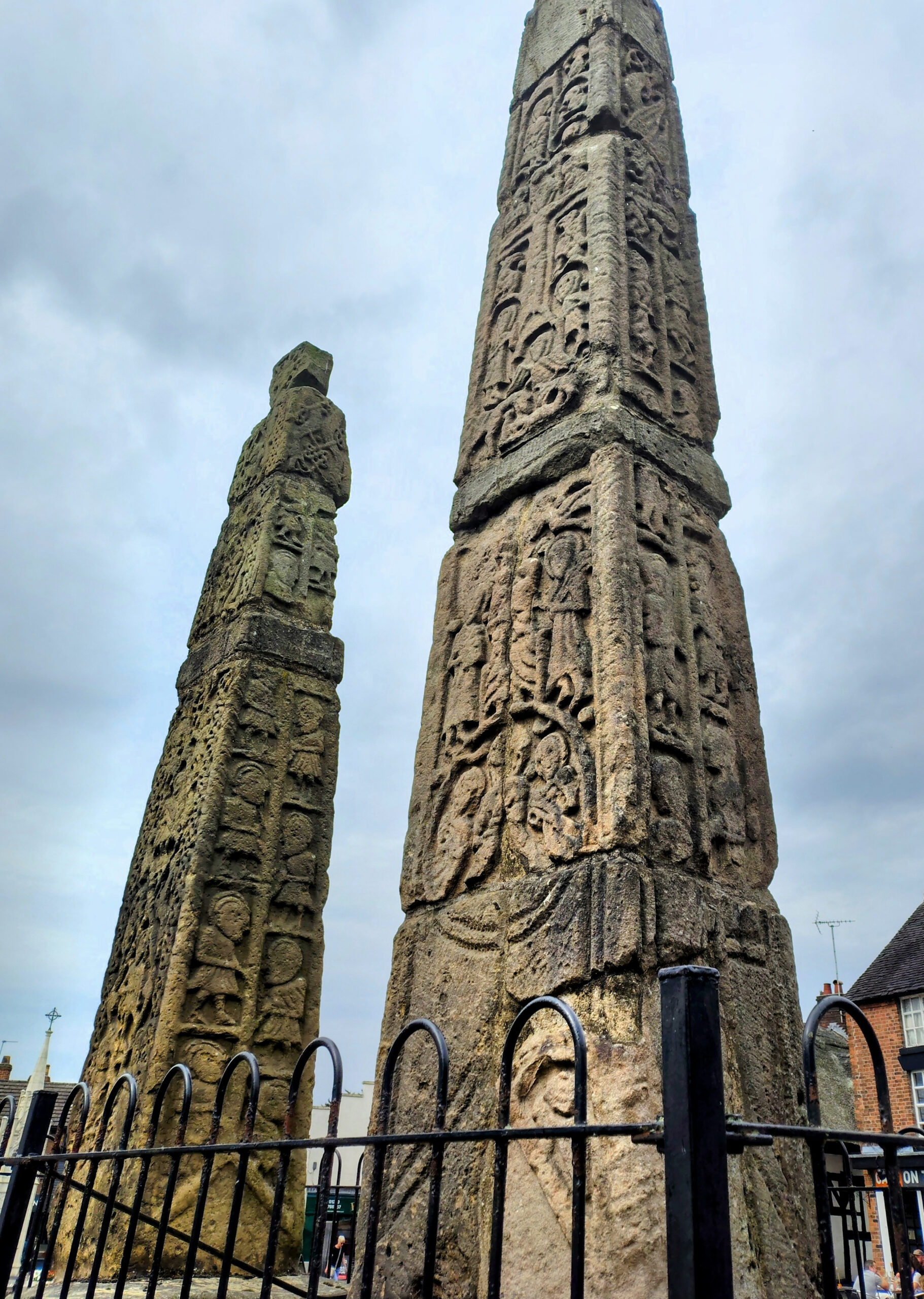
The crosses display rich ornamentation and early Christian figural scenes, including the Adoration of the Magi and the Nativity. All faces of the crosses are carved with figures, animals, and vine scrolls, while other panels show varied motifs of creatures and foliage. The figures are characterised by thinly outlined heads and pleated skirts with scalloped hems. Animal ornament is consistent with heraldic poses and winged beasts with gaping muzzles. [9] The original form of the crosses’ heads is uncertain, though two surviving arms, each defined by concave curves, reflect a design common in Northumbria, though in this instance they may have belonged to a large circular head with three open circles, set between the arms. [10]
Precursors to the cross in Christianity and Judaism included sacred trees and pillars. [11] Bintley explores this in his study of the ‘Ancestors of Christ’ panel on the southern cross, where sacred rods, branches and staffs beside eight of thirteen figures symbolise arboreal imagery in early medieval spirituality [12]. Such symbols may have marked a transition from tree veneration to the doctrine of the crucifix, [13] with Eden’s trees of life and death serving as precursors to the cross as tree of life. [14]
In pre-Christian Britain, stapols were sacred posts or pillars “not merely commemorative, but more potent: markers denoting important places conceived as significant in local identity, myth and legend.” [15] The vertical structure of the cross may symbolise the axis mundi, a mythological motif linking heaven and earth, with figural panels ascending toward divine revelation. [16] As “didactic and symbolic structures,” the crosses mediated between earthly viewers and divine truths in a cosmological model that saw the vertical shaft as a conduit, anchoring ascent. [17] In many cultures the centre of a temple was the axis mundi, anchored to the apparent dome of the sky, creating a bipartite division of the world – above and below the horizon. [18] There are early medieval parallels that mirror the symbolic axis mundi in the form of timber uprights that point to the symbol of a ‘world-pillar, a cosmic axis’. Referred to as Irminsul, the most notable historical account records one being destroyed by Charlemagne in 772, at a time when heathens in Hesse, in present-day Germany, were venerating the Robor Lobis, the Oak of Jupiter. [19] Comparable monuments, known as Jupiter Columns, are also attested. [20] Later Romanesque adaptations of this Germanic symbolism depict columns “supporting the sky or reaching to the gods.” [21]
The crosses were erected with their sides facing north, south, east, and west. The lozenge pattern on the eastern side of the smaller cross is thought to represent the four cardinal directions. [22] At the base of the larger obelisk is a circular motif enclosing several figures, oriented towards the east. This arrangement has been interpreted as an ecclesiastical allusion to sunrise, recalling similar carvings on monumental obelisks in regions once associated with sun‑worship. [23] The symbol of the four‑armed cross relates to the ritual importance of the two solstices (summer and winter) and the two equinoxes (spring and autumn). It later evolved into the Germanic four‑spoked wheel cross, seen on Swedish rock carvings evoking a ‘sky wheel,’ before becoming the Christian cross. [24]
Dragon-like creatures or serpents appear at least seven times on both crosses. In one instance, their long tongues are tied in a double Staffordshire knot over what is believed to have been Peada’s heathen followers. [25] Within Scandinavian cosmology, the World Serpent is frequently portrayed as encircling the vast ocean, surrounding the earth, at whose centre stands the World Tree. While the tree offers sustenance to the valleys below, its roots are simultaneously gnawed and eroded by various creatures, including serpents. [26]
The Sandbach Crosses potentially redefined a frontier space as a symbolic centre, their imposing scale ensuring visibility as focal points for assemblies, processions, and public gatherings. At the same time, the vine scrolls, animal forms, vertical axis and solar symbolism, evoked broader early medieval cosmological motifs, linking the monuments to a landscape already imbued with mythic and ancestral resonance.
References
- Tait, A.C.F. (1946) The Sandbach Crosses. Paper presented at the Society of Antiquaries of London, September 1946.
- Tait, A.C.F. (1946) Ibid.
- Heywood, N. (1911) ‘The Crosses at Sandbach’, Transactions of the Historic Society of Lancashire and Cheshire, 29
- Hawkes, J. (2002) The Sandbach Crosses: Sign and Significance in Anglo-Saxon Culture. Dublin: Four Courts Press.
- Tait, A.C.F. (1946) Ibid.
- Radford, R.A. (1956) The Sandbach Crosses, Cheshire. London: HMSO.
- Ormerod, G. (1816) The History of the County Palatine and City of Chester. Vol. 3. London: Lackington, Hughes, Harding, Mavor, and Jones.
- English Heritage. Sandbach Crosses: History. Available at: https://www.english-heritage.org.uk/visit/places/sandbach-crosses/history/
- Hawkes, A.J. (1989) The Non-Crucifixion Iconography of the Pre-Viking Sculpture in the North of England: Carvings at Hovingham, Masham, Rothbury, Sandbach and Wirksworth. PhD thesis. Newcastle University.
- Tait, A.C.F. (1946) Ibid.
- Bintley, M.D.J. (2013) ‘Recasting the role of sacred trees in Anglo-Saxon spiritual history: the South Sandbach Cross “Ancestors of Christ” panel in its cultural contexts’, in Bintley, M.D.J. and Shapland, M. (eds.) Trees and Timber in the Anglo-Saxon World. Oxford: Oxford University Press.
- Bintley, M.D.J. (2013) Ibid.
- North, R. (1997) Heathen Gods in Old English Literature. Cambridge: Cambridge University Press.
- Karkov, C.E. (2001) Text and Picture in Anglo-Saxon England: Narrative Strategies in the Junius 11 Manuscript. Cambridge: Cambridge University Press.
- Semple, S. (2013) Perceptions of the Prehistoric in Anglo-Saxon England Religion, Ritual, and Rulership in the Landscape, Oxford University Press, Oxford.
- Waddell, J. (2018) Myth and Materiality. Oxbow insights in Archaeology. Oxbow books. Oxford.
- Hawkes, A.J. (1989) Ibid.
- Prendergast, F. (2015) An Architectural Perspective on Structured Sacred Space-Recent Evidence from Iron Age Ireland. In Skyscapes in Archaeology: The Role and Importance of the Sky, edited by Silva, F & Campion. Oxbow Books. Oxford & Philadelphia.
- Semple, S (2013) Perceptions of the Prehistoric in Anglo-Saxon England: Religion, Ritual, and Rulership in the Landscape. Oxford University Press. Oxford.
- Browne, G. F. (1916) The Ancient Cross-shafts at Bewcastle and Ruthwell, Cambridge
- Browne, G. F. (1916) Ibid.
- Harper, C.G. (1909) The Manchester and Glasgow Road: This Way to Gretna Green. London: Chapman & Hall.
- Harper, C.G. (1909) Ibid.
- Green, M.J. (1991) The Sun-Gods of Ancient Europe. Batsford, London.
- Tait, A.C.F. (1946) Ibid.
- Davidson, H.R.E. (1988) Myths and Symbols in Pagan Europe: Early Scandinavian and Celtic Religions. Manchester: Manchester University Press.